Tuesday, May 10, 2011

2.7 Questions- Destruction by Tropical Cyclone Larry

1. On the 20th of March, the eye of Cyclone Larry crossed the coast near Innisfail between 6:20am and 7:20am.
2. They experienced the greatest damage because it caused major flooding and left many communities isolated for several days.
3. Public infrastructure are things such as roads, rail and air transport that the public uses. The damage was brought on the infrastructure made if very difficult to transport nessessities such as food, water and shelter to the effected areas.
4. The total damage bill as AU $350 million.
5. Cyclone Larry destroyed 85% of the banana crops in North Queensland. It left thousands of people without employment and $298.4 million were lost from the destruction of the crops.
6. The Emergency Management Australia and State Emergency Service both help to produce information brochures on natural hazards and run community workshops to ensure that people are well prepared.
7. Emergency Management Australia, State Emergency Service, Australian Defence Force, charities and government departments.
8. They helped the coordination of the recovery effort and helped provide large quantities of resources needed to remove danger and repair damage.
9. Major General Peter Cosgrove. He would need to have good leadership qualities and be able to organise large groups of people to help with the recovery effort. He would need patience as the recovery would take time.
10.
11. It would interrupt the supply of bananas for weeks and maybe months as so much of the crop was lost and many factories exporting the bananas would be impossible to get to with the flooding.
12. a) 800km
b) 66.6 km/h
c) It was downgraded to a tropical low at 1am on March 20th. This is because the wind had lost its momentum that it gained over the sea.
d) It travelled around 1000km inland before it receded.  

Monday, May 9, 2011

2.6 Questions- Cyclone Tracy

1. 1974

2. They set up evacuation and medical centres

3. The National Disaster Organisation is a federal government body and it became involved with cyclone Tracy to help restore basic services to Darwin

4. To save lives

5. 80.459% of Darwin’s population were evacuated

6. Houses in all cyclone-prone areas of Australia must adhere to strict building codes to withstand cyclone. Also lessons have been taught how to prepare against this hazard

7. On the 29th of August Hurricane Katrina hit the Gulf of Mexico and the state of Louisiana in the United States. It killed over 1400 people and flooded large areas of New Orleans

8. When the hurricane hit, the storm surge combined with the low-lying nature of the New Orleans meaning that 80% of the city became flooded.

9. All levels of Government were criticised for the slow and disorganised response to the hazard

10.  The NDO was quick and organised to send out food supplies and medical services while the FEMA was criticised for being slow and took days to send out food supplies

11.


12.
a)      Cyclone Tracy was heading at a fast speed South-East straight through Darwin

2.5 Questions- Tropical Cyclones

1. If the air pressure in the upper atmosphere is relatively high it will limit the altitude that the warm, moist air can rise to. This high pressure causes the rising air to spiral outwards thus forming a tropical cyclone.
 
2. They form in the tropic of Capricorn throughout November through April.

3. The most areas that are at risk in Australia are Queensland and the Northern Territory.

4. 6 are likely to cross the Australia’s coastline per year.

5. The other names for tropical cyclones are Typhoons and Hurricanes.

6. Tropical cyclones develop in the tropical regions of the world. Heat from the sun causes warm, moist air to rise into the atmosphere. As the air rises, a low pressure system forms and condensation occurs, which releases latent heat causing the air to rise further into the atmosphere is high, then the rising column of warm air will spiral outwards in the upper atmosphere and air will rush from the surface to replace it, forming a tropical cyclone.

7.  The eye of a tropical cyclone is the middle where there is a pipe-like hollow centre.

8.


9. The tropical cyclone is downgraded to a tropical storm when it moves to cooler water and loses its energy supply of warm, moist air.

Mapping Work

Questions- 
1. What is it about the pressure system stalled over Australia that relates to the weather over the next 4 days?
There is a high pressure system over Australia with clear skies and stable conditions.
2. What is the air pressure in each of the next 4 days for each of the capital cities? How does this correspond with the predicted weather for these cities?
There is high pressure system over the country which generally means that most of the capital cities will have clear skies and stable conditions but a few of the cities including Perth and Melbourne will have light showers.

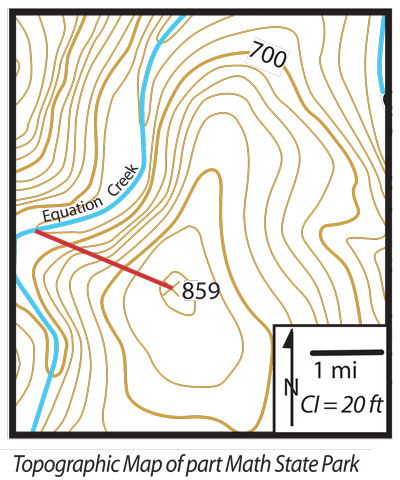
1. What is the contour interval (sometimes abbreviated CI)? Convert to metric.
20 ft.

2. What is the scale of the map? Convert it into the metric system
Contour Line is 20ft
3. What is the gradient of the line? Calculate in metric system.

Sunday, May 8, 2011

2.8 Questions- Studying the Weather

1. a)
i. 1016
ii. 1010
iii. 1016
iv. 1020

b) Adelaide
c) Cool conditions will flow through Melbourne with a chance of isolated showers.
d)
i. Wind
ii. Precipitation
iii. Precipitation and wind direction

e) Hobart would have the strongest winds because they are closer to the winds direction and are also surrounded by water which would bring stronger on shore winds which would be powerful and cold.

Saturday, May 7, 2011

2.2 Questions- Landslides, Earthquakes and Tsunamis

1. Landslides involve the movement of a mass of rock or sections of the Earth's crust under the force of gravity.


2. Human actions usually cause a landslide but also heavy rainfall or undercutting of banks and cliffs from rivers.


3. They can build cities on the side of mountains. De vegetation and construction or roads and railways.


4.  An earthquake is an intra-plate tension where movements occur along cracks and faults in the Earth's crust. They are measured by a Richter scale.


5. They are mainly caused by the tectonic plates rubbing across each other underneath Australia.


6. Every 15 months, because we have created buildings  that are earthquake ready.


7. 35000 homes and 3000 other buildings being moderately impacted and 13 people were killed and 120 people were injured.


8. A landslide is usually caused by weather and are very small compared to earthquakes which can go for kilometres and are caused by the tectonic plates.


9. A tsunami is a wave caused by the movement of the Earth's crust.


10. Earthquakes, landslide or volcanoes.


11. When movement of the ocean floor occurs it creates a major ripple in the ocean causing the water to move. When the tsunami  reaches a beach or shallow water the water recedes before


12. Sudden retreat of water, feeling of earthquake and roar of the water coming.


13. An under sea earthquake.


14. 23. 20 minutes


15. The tsunami grows as it reaches shallow water and creates a growing sound.


16. The coordinated the development of a tsunamis warning system.


17. He is a geoscience professor. He says that the Alpine Fault hits NSW ever 500 years and could reach up to Parramatta. 


18. a) 10N, 100E
b) i. 3 hours
ii. 10 hours
iii. 5 hours
iv. 10 hours


19. At 11:35pm on Wednesday, 30 July a landslide consisting of 2000 cubic meters mud and rock moved rapidly down Alpine Way. The landslide was devastating, taking with it Carinya Ski Lodge, then passing through Bobuck Lane slamming into an elevated car park and then plummeting directly into Bimbadeen Lodge. With 18 precious lives lost the town of Thredbo was deeply saddened and many of the lives lost were locals or the town not just tourists.
Much of the local environment, especially the ski lodges, car park and many shops were destroyed when the landslide hit and it took many days for all of the debris to be cleaned.

Thursday, May 5, 2011

Natural Hazards- Bush Fire- Different Groups

Local Councils-


How they could help:

  • They could send out warning signals when the bush fires are coming closer and closer to the community
  • Local councils could help with families rebuild their lives
  • They could set up meeting with the community to give them advice when a bush fire happens
Insurance Companies


  • They can  help people financial by giving them repayments which can help them 'get back on there feet'.
  • A lot of money is paid out and it can affect the business industry.
  • Help them to repay there possessions.
  • They can help to give money to people who don't have jobs due to bushfires e.g. farmers whose crops have been burnt.
  • They can give money to people for funerals and life insurance repayments.

Monday, May 2, 2011

Natural Hazards- Bush Fire

Social-


  • People may lose family members affecting them mentally
  • Their house and all of their personal possessions that they have ever owned which could have been destroyed.
  • Their community with all of their shops, ovals, school and community places could be lost.
  • Their friends may have died affecting their relationships with their friends in the community.
  • If they are in heavily populated bushland area and away from the rest of the country isolation for a while would occur.
Environment-

  • Exotic animals can become wiped out and may get extinct which would disturb the food chain 
  • Exotic flora can get wiped out and may even become extinct 
  • Lots of carbon dioxide would be emitted into the air which would poison the oxygen in the and make it harder to breath
  • Land covered with dead trees and destroyed fauna could make the land uninhabitable
Economic-
  • Farmers crops can be burnt and destroyed therefore loss of income.
  • Houses can be burnt down and many people can't afford to rebuild/repair.
  • Hard to get to because normally in the bush/ it costs a lot to put out and to get to.
  • The farming industry is affected and less food is produced for people therefore food has to be imported costing a lot of money.
  • Insurance companies lose a lot of money and it affects the insurance industry.